Dead Sharp by Len Wanner
A collection of interviews with nine Scottish crime writers
£5.99
Since this is an ebook blog, first question has to be: what kind of relationship do you have with ebooks?
Nice – hit first and hit hard. Mr Guthrie, you gent, straight in there with a relationship question. Naughty. Right so, let's skip the foreplay!
My relationship with ebooks is that rarest of relationships shared by Catlic priests and their innocent flock. I believe in the redemptive power of ebooks. I believe in the spiritual rebirth of the e-published author. I believe in the e-publisher who takes a leap of faith on prodigal ebooks. And I believe in the rewards of impulsive indiscretions with that cheap and cheerful flock.
Can you sum up Dead Sharp in a paragraph?
When I started working on this collection of interviews with Scottish crime writers, I hoped it would allow writers and readers to sidestep today's marketing stampede. I've since come to think of Dead Sharp as nine sideways reflections on crime fiction, the books and everything it takes to get them written, retailed, and read.
But it's not for me to say I succeeded, so I'll refer you to David Corbett:
"Len Wanner is a gift to any serious writer, but especially contemporary crime writers, who see their genre not as some ghettoized backwater of the entertainment industry but the legitimate heir of the social and political novels that seem to have lost their caché in literary circles. Wanner understands that crime provides a unique and crucial perspective on the tensions not just between the individual and society but society and the state, tradition against change, wealth against poverty, conformity against liberation, as well as the ever-present corrupting influence of power. The writers he chooses to interview all share a critical eye of modernity and a commitment to literary skill. More importantly, he has that rare gift for not just putting them at ease but leading them into the thornier realms of creativity and contemplation, where the juices run dark and the questions often remain unanswered--but never unaddressed. The interviews are insightful gems, full of invention, wit and cleverness as well as the honesty and perceptiveness one expects from men and women whose job is to craft well-told tales. Wanner captures these writers at their best, lures them into unconventional terrain and obliges improvisation, with bracing results. You will have to look far and wide for any more interesting, informative and just plain engaging dialogues with writers than those Len Wanner provides here."
And yourself - who is Len Wanner?
Len Wanner was born in the alpine republic of Bavaria. Having graduated from University College Dublin and authored
Dead Sharp: Scottish Crime Writers on Country and Craft, he currently lives with his lady friend in and out of the University of Edinburgh where he is patiently finishing a PhD on Scottish crime fiction and not so patiently awaiting royal patronage. In the meantime, he works as a freelance translator and editor of
TheCrimeOfItAll.
Why the interest in Scottish crime fiction particularly?
Having grown up in Bavaria, I have a deep respect for any culture that celebrates masculinity by donning fetish wear.
I also have a deep respect for transgressive writing that is free of anti-intellectual bias and full of bile when it comes to the antics of the intelligentsia. There's a lot of that in Scotland. At its best, that kind of crime fiction is tempered by a self-deprecating sense of humour and tendered by a self-conscious sense of compassion. You tend to learn something about yourself while you're having a good time with those books.
But I think it's the Lederhosen/Kilt connection that got me into it.
How hard was it to choose which authors to include in the book?
As hard as Chinese arithmetic. I'd read the
Paris Review Interviews, the
two Badlands books by John Williams, and the
two interview collections by Craig McDonald to get a sense of how your lineup can turn a short list of separate interviews into an extended conversation about a shared topic. So I had to hold off on including some of my personal favourites and well-known Scottish crime writers simply because their interviews didn't fit into the company of the final nine, never mind the space of 250 pages.
In short, I wanted to afford readers two equally rewarding reading experiences: Read one interview, go read a few of the interviewee's books, then continue accordingly with the other interviews, or read them all back to back. Either way, rather than concentrating on one area of 'Tartan Noir', you should get a comprehensive overview from these nine interviews, which is why I chose authors who would represent the diversity of sub-genres, styles, settings, themes, politics, aesthetics, and voices at work in Scotland today. Completing that overview would take another book length collection.
How much research did you do before interviewing the authors?
You're one of the interviewed authors, so perhaps you should be the judge of that. You or my legion of readers.
I'd like to think that I did the right kind of research to ask informed questions and still be intuitive in directing the interview when authors answered questions I never asked.
What research did I do? I watched every youtubed session of James Lipton having his wicked way Inside the Actors Studio. Then I gave up on linear biography questioning and discovered the art of interviewing in the afore-mentioned collections. As for the critical context, it certainly benefited my research that I've been doing a PhD on Scottish crime writing for the past three years. That and the fact that I like most of the fiction enough to read it in my spare time, so I'd read at least half their books before interviewing the nine authors.
But what really proved invaluable was reading some of the previous interviews each author had done. Sure, the odd time I found a question that was asking to be plagiarised, but more often than not I found out which questions not to ask. It pays to learn from others just how easily authors can be bored into some truly awful answers.
Putting you on the spot, but which interview was most fun?
Yours. But I won't go into it. A gentleman never tells.
What was the most surprising discovery you made during the interviews?
That everything can go wrong. Take Louise Welsh's interview: I'd read all her books and most of her previous interviews. I'd even prepared several lists of questions just in case I'd be struck down by jet lag Liptomania. Of course, I knew that doing the interview in Glasgow's college of art would test the mettle of even this man of chilled steel, but what I don't know is whether Miss Welsh put my hobo chic down to the occupational hazard of losing my way in the settings of her novels. I got there on time and in one piece, but the worse for wear after straying through a sweltering West End on the aggressive side of charming, and I'd hate to think she took my state as a comment on her work. In the end, she had the good grace to be more attentive to my questions than my grooming. My apologies for sweating on your parade, Louise.
Can you give me some tips on how to improve my interviews?
Well, as you know from having read my book, there's a short essay on interviewing in the back of Dead Sharp. That includes ten tips on how to improve anyone's interviews.
As for your interviews, I think you should always ask my favourite final question: "What do you know now that you wish you'd known when you started writing?
Who would you most like to interview?
Bernard Pivot. Anyone who's watched Jimmy Lipton climax with his Proust Questionnaire knows that the man has a lot to answer for.
What's next?
The second volume of interviews with Scottish crime writers. I don't have a title yet, but I'm half way through the lineup and this much I can tell you: It's gonna be dead sharp.
Cheers, Len. Looking forward to chatting to you further next week.
***
Indeed, Len and myself will be 'in conversation' at a free event at Edinburgh University next Thursday, 22nd Sept. Details follow:
University of Edinburgh
Ground Floor Lecture Theatre
Hugh Robson Building
George Square
Thu 22nd Sept, 6.30pm-7.45pm
Join us for what promises to be a fun, eventful and informative evening in celebration of Scottish crime fiction as Len Wanner discusses his highly acclaimed collection of in-depth interviews with some of Tartan Noir's finest exponents, DEAD SHARP: SCOTTISH CRIME WRITERS ON COUNTRY AND CRAFT, with digital publisher, literary agent and award-winning crime novelist, Allan Guthrie.
Dead Sharp by Len Wanner
A collection of interviews with nine Scottish crime writers
£5.99

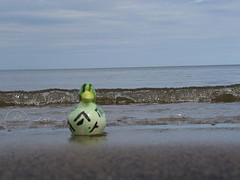 Next weekend sees the third Portobello Book Festival, which takes place in Edinburgh's seaside (photo by Andrew Girdwood). The festival is organised by a group of local enthusiasts in conjunction with Portobello Library.

